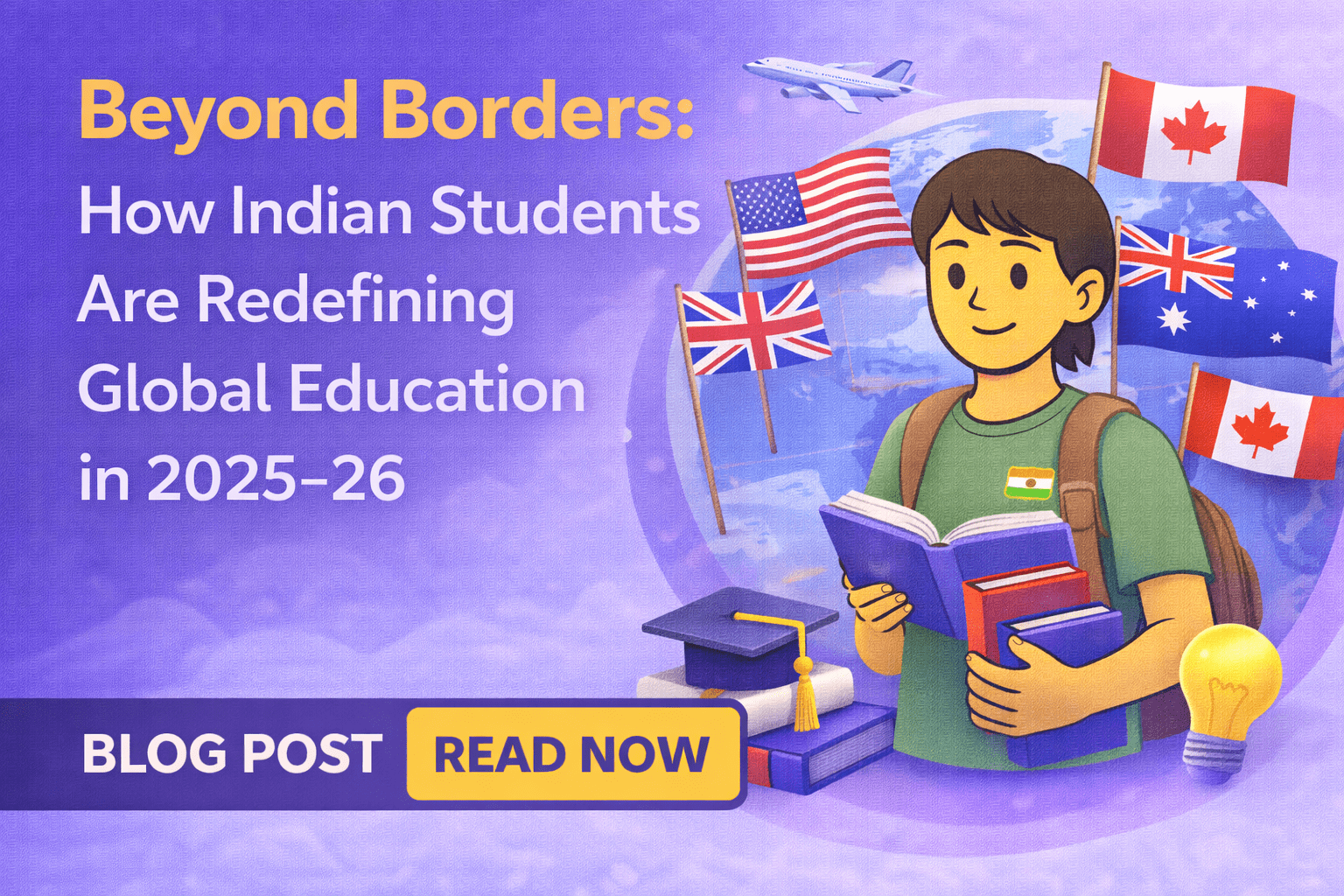
For decades, global education followed a familiar pattern for Indian students: a limited set of countries, conventional degree choices, and a linear path from admission to migration. That narrative is rapidly changing.
In 2025–26, Indian students are no longer just participants in global education—they are active architects reshaping how, where, and why international education happens. From choosing unconventional destinations to prioritizing skills over status, Indian students are driving a fundamental shift in the global education ecosystem.
This transformation reflects deeper changes in mindset, technology, economics, and global opportunity.
India remains one of the world’s largest contributors to international student mobility. According to global education estimates, over 1.3 million Indian students are currently studying abroad, a number expected to grow steadily through 2026 despite rising costs and stricter visa policies.
What has changed is not the ambition—but the definition of success.
Today’s Indian students are asking sharper questions:
What skills will this degree give me?
Is the return on investment worth it?
Will this education make me globally employable—not just internationally mobile?
This shift is redefining global education from a destination-driven journey to a purpose-driven strategy.
For years, the US, UK, Canada, and Australia dominated Indian students’ choices. While these countries remain popular, 2025–26 marks a clear diversification trend.
Indian students are increasingly choosing:
Germany for tuition-free or low-cost public education
Ireland for strong post-study work opportunities
Netherlands for English-taught STEM programs
France and Italy for business, fashion, and design
Singapore and the UAE for regional career hubs
This diversification is driven by:
Rising tuition and living costs in traditional destinations
Tighter visa regulations
Greater awareness of alternative high-quality education systems
Indian students are proving that global education does not require following a single, crowded path.
One of the most defining trends of 2025–26 is the shift from brand-name universities to outcome-driven programs.
Indian students are increasingly prioritizing:
STEM, AI, data science, cybersecurity, and business analytics
Industry-integrated curricula
Internships, co-op programs, and applied learning
Employability metrics over university rankings
Degrees are no longer seen as certificates of prestige—but as launchpads for global careers.
This is particularly evident in:
Master’s programs with strong industry partnerships
Shorter, skill-intensive courses
Specialized diplomas and professional certifications alongside degrees
Global universities are adapting quickly—redesigning curricula, strengthening employer ties, and actively recruiting Indian students who bring both academic strength and professional ambition.
Technology has radically democratized access to global education.
In 2025–26, Indian students prepare for international journeys using:
Online IELTS, TOEFL, and PTE coaching
AI-powered mock tests and feedback tools
Virtual university fairs and counseling sessions
Remote application and documentation processes
English proficiency tests themselves have evolved, with computer-based testing, faster results, and flexible scheduling, making global education accessible even beyond metro cities.
This digital shift has:
Reduced dependency on traditional agents
Increased transparency
Empowered students to make informed, independent decisions
Indian students today are among the most digitally self-reliant global applicants in the world.
Perhaps the most striking evolution is financial maturity.
Unlike earlier generations, today’s students and families are ROI-focused. They evaluate:
Tuition vs post-study earning potential
Scholarship availability
Cost of living
Work rights during and after study
Countries offering post-study work visas, PR pathways, and job market access are gaining preference over those offering prestige alone.
This shift has also increased demand for:
Merit-based scholarships
Flexible payment structures
Shorter-duration master’s programs
Indian students are treating education as a strategic investment, not an emotional decision.
The idea that global education must be fully on-campus from day one is fading.
In 2025–26, students are embracing:
Hybrid programs (part online, part on-campus)
Pathway programs and credit transfers
Online-first learning followed by overseas exposure
These models reduce cost, increase flexibility, and allow students to adapt to changing global conditions—economic, political, or personal.
Universities are responding by designing modular, stackable learning experiences, and Indian students are among the fastest adopters.
Indian students are no longer viewed merely as international fee-payers. They are increasingly recognized as:
Innovation contributors
Startup founders
Researchers
Cultural ambassadors
With strong English proficiency, technical expertise, and adaptability, Indian students are shaping classrooms, labs, and workplaces worldwide.
In many countries, Indian graduates are filling critical skill gaps, particularly in technology, healthcare, and engineering.
This has repositioned Indian students as strategic global talent, not just international applicants.
English proficiency tests remain a gateway—but their role has evolved.
In 2025–26:
Students aim for functional fluency, not just scores
Speaking and communication skills matter more than ever
Universities value real-world English usage
IELTS, TOEFL, and PTE preparation is now seen as career readiness, not exam preparation.
Indian students increasingly view English as a global workplace skill—one that enables leadership, collaboration, and influence.
Perhaps the most profound shift is philosophical.
Global education is no longer synonymous with permanent migration. Many Indian students now aim to:
Work internationally for a few years
Build global networks
Return to India with global experience
Launch startups or leadership careers
This “global exposure, local impact” mindset is redefining what success looks like.
The world is no longer a one-way destination—it’s a two-way exchange of knowledge, skills, and opportunity.
As Indian students continue to redefine global education, institutions worldwide must adapt.
The future belongs to universities and platforms that:
Focus on employability
Offer transparency and flexibility
Understand Indian student aspirations deeply
Support long-term career outcomes, not just admissions
Indian students are setting new global standards—for preparedness, ambition, and adaptability.
In 2025–26, Indian students are not simply crossing borders—they are expanding them.
They are redefining where education happens, how it is valued, and what it leads to. With clarity, confidence, and global vision, Indian students are shaping a future where education is not about geography—but about possibility.
Global education is evolving—and Indian students are leading that evolution.
WhatsApp us